
Why Do People Like AI Characters?
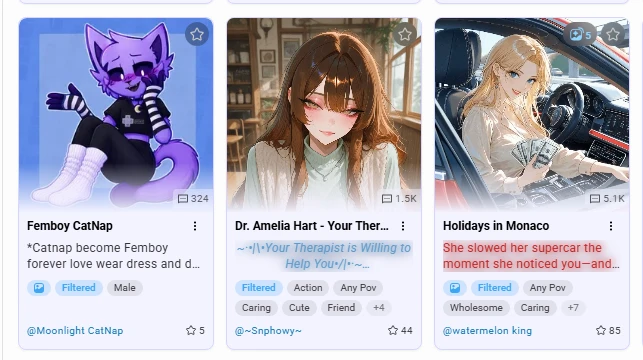
AI characters are liked because they provide personalized interaction, emotional engagement, and creative freedom that traditional media cannot offer. Platforms using AI characters reached millions of users by 2024, with Character.AI reporting more than 20 million monthly active users during its growth period. Surveys on digital companionship show that users often choose AI characters because of availability (24/7 interaction), customization, and the ability to create unique conversations. Around 70% of users in several AI companion surveys reported that personality customization improved their engagement, showing that people are attracted not only to artificial intelligence itself but also to the experience of interacting with a character designed around their preferences.
AI characters create a different type of relationship compared with traditional fictional characters. A movie character, game character, or novel character follows a fixed storyline, while an AI character responds to individual users and changes based on conversations. This difference turns passive entertainment into active participation.
Research in human-computer interaction has shown that people naturally respond socially to systems that display language skills, emotional responses, and consistent personalities. The 1996 CASA (Computers Are Social Actors) studies demonstrated that users often apply social expectations to computers even when they understand that the system is not human. Later studies in 2022 and 2023 continued to show that conversational quality and personalization strongly influenced user satisfaction.
“People do not need an AI character to be human. They need the interaction to feel personal, consistent, and meaningful.”
This personal feeling comes mainly from customization. Most entertainment characters are created for millions of people at the same time, but AI characters can adapt to individual preferences. Users can choose personality traits, speaking styles, interests, backgrounds, and conversation topics.
A 2024 analysis of AI companion applications found that personalization features increased average conversation time by more than 30% compared with basic chatbot functions. Users were more likely to return when the AI remembered previous conversations or maintained a recognizable personality across sessions.
The ability to build personalized experiences also explains why AI characters have become popular in creative communities. Writers use AI characters to test dialogue, gamers use them for role-playing scenarios, and casual users create fictional companions for entertainment.
The growth of AI characters is also connected with the human preference for interactive storytelling. Traditional stories allow audiences to imagine themselves inside fictional worlds, but AI characters allow users to directly participate in those worlds.
For example, a fantasy fan can create conversations with a fictional warrior, a science fiction enthusiast can design a futuristic assistant, and a language learner can practice conversations with a virtual partner. According to a 2023 report on digital entertainment behavior, more than 60% of younger digital users preferred interactive experiences over purely passive content formats.
This preference for participation has expanded into different areas, including emotional companionship. Many users interact with AI characters because they provide immediate responses without the social pressure that can exist in human conversations.
Studies on AI companionship published between 2020 and 2024 found that users often valued three features: constant availability, non-judgmental communication, and emotional expression. In one survey involving over 1,000 chatbot users, approximately 50% reported using AI companions during moments of loneliness or stress.
AI characters can provide a comfortable environment for users who want to talk, reflect, or practice communication. The interaction does not require scheduling, social preparation, or concern about another person’s reaction.
“The attraction comes from easy access to conversation, not from replacing human relationships.”
Another reason people enjoy AI characters is curiosity about artificial personalities. Humans have always been interested in imaginary beings, from fictional heroes to virtual assistants. AI technology adds the ability for these characters to respond and develop through interaction.
This has created new categories of digital experiences, including role-playing companions, virtual influencers, and adult-oriented conversational systems such as sex ai chat. These applications use similar AI technologies but focus on different user needs, including entertainment, fantasy interaction, and personalized conversations.
The popularity of AI characters is also supported by improvements in natural language models. Earlier chatbots often produced repetitive answers because they relied on limited response databases. Modern large language models introduced after 2020 can generate more flexible conversations by analyzing context, language patterns, and previous messages.
For example, GPT-based systems and other large language models can maintain longer conversations, understand emotional expressions, and adjust communication styles. A 2023 Stanford evaluation of language models showed significant improvements in reasoning and dialogue quality compared with earlier generations released before 2020.
Better technology has made AI characters feel more stable and engaging, but users are still aware that they are interacting with artificial systems. This balance between imagination and reality contributes to their popularity.
People enjoy pretending, creating stories, and exploring different personalities while knowing that the character is artificial. Similar behavior already existed in gaming communities where players formed emotional connections with fictional characters.
AI characters simply add another layer by allowing direct conversation. A player no longer only controls a character’s actions; they can discuss ideas, ask questions, and influence the relationship through language.
The social environment around digital communication has also changed. Younger generations have grown up using online communities, multiplayer games, social platforms, and virtual identities. According to Pew Research Center data from 2023, more than 95% of teenagers in the United States reported having access to a smartphone, creating a generation familiar with digital interaction.
Because online communication is already part of daily life, AI characters are easier for many users to accept. A virtual companion feels less unusual when people already communicate through avatars, online communities, and digital profiles.
AI characters are also used for practical purposes beyond entertainment. Some users practice foreign languages with AI characters because they can repeat conversations without time limits. Others use AI characters for brainstorming, learning, or creative writing.
A 2024 education technology review showed that conversational AI tools improved learner participation in some language-learning settings, with engagement increases of around 20% to 40% depending on the platform and study design.
The future development of AI characters will likely focus on stronger memory systems, voice interaction, visual avatars, and personalized environments. Companies are already combining text, speech, and image technologies to create characters that can communicate through multiple channels.
However, the development of AI characters also requires careful consideration of privacy, transparency, and emotional influence. Users need clear information about how AI systems work and how personal conversation data is handled.
The popularity of AI characters comes from several connected reasons: people enjoy personalized conversations, interactive storytelling, creative freedom, and easy access to communication. AI characters succeed because they combine technology with familiar human activities such as storytelling, imagination, and conversation. As artificial intelligence continues to improve, these digital characters will likely become a larger part of entertainment, education, and online communication.